
| Core Fact | Kozhikode District Details |
|---|---|
| Geographical Location / Status | A coastal district in North Keralam, on the Malabar Coast. It is bordered by Kannur, Wayanad, Malappuram, and the Arabian Sea. |
| District Headquarters | Kozhikode |
| Total Land Area in sq km | 2,345 sq km |
| Population as per latest available Census data | 30,86,293 as per Census 2011 |
| Literacy Rate | 95.08% |
| Number of Rivers / Major Rivers | Exact number not clearly available from official public sources. Major rivers include Chaliyar, Kallayi, Korapuzha, Kuttiady, Agalappuzha, and Panurpuzha. |
| Revenue Divisions | 2 — Kozhikode and Vadakara |
| Taluks | Kozhikode, Vadakara, Koyilandy, Thamarassery |
| Municipalities | Vadakara, Koyilandy, Ramanattukara, Feroke, Payyoli, Koduvally, Mukkam |
| Number of Grama Panchayats | 70 |
| Assembly Constituencies | 13 — Vadakara, Kuttiadi, Nadapuram, Quilandy, Perambra, Balusseri, Elathur, Kozhikode North, Kozhikode South, Beypore, Kunnamangalam, Koduvally, Thiruvambady |
| Lok Sabha Constituency / Constituencies | Kozhikode district is connected with Kozhikode, Vadakara, and Wayanad parliamentary constituencies through different Assembly segments. |
| Official District Website | Kozhikode District Website |
The core district area, population, literacy rate, revenue divisions, taluks, municipalities, panchayats, and villages are verified from the official Kozhikode district administration pages. Election-related Assembly constituency data is verified from the Chief Electoral Officer, Keralam.
What Makes Kozhikode Unique?
Kozhikode district is one of Keralam’s most historically important coastal districts. It was known internationally as Calicut. The district was a major spice-trade centre on the Malabar Coast. The official district history identifies Kozhikode as the former capital of the Zamorins and a renowned commercial centre.
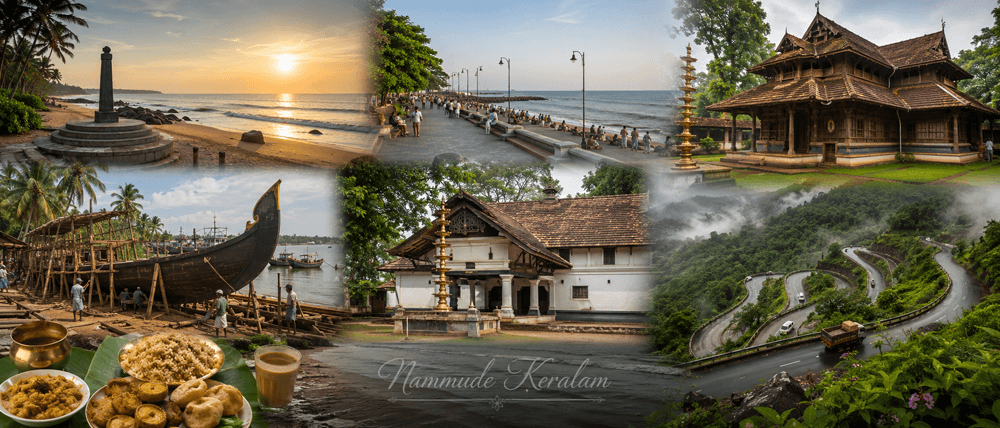
Kozhikode Keralam has a strong maritime identity. Its coastline faces the Arabian Sea. Kappad Beach is associated with Vasco da Gama’s arrival in 1498, which made Kozhikode important in global trade history.
The district is also known for Malabar culture. Malayalam is the main language. English is used in education, business, tourism, and official communication. Tamil, Hindi, Urdu, and other languages are also heard among migrant workers, traders, and travellers.
Kozhikode has a visible cultural mix. Temples, mosques, churches, traditional markets, old trading areas, and coastal settlements shape the district’s identity. Tali Shiva Temple, Kuttichira, Mishkal Mosque, Mananchira, Beypore, and Kappad are important local heritage anchors.
Kozhikode is also known for food culture. Kozhikode halwa, Malabar biryani, seafood, snacks, and traditional bakery culture are strongly linked with the district’s public identity.
In 2023, Kozhikode was recognised by UNESCO as India’s first City of Literature. This adds a modern cultural identity to its older trade and maritime history.
Geography and Administrative Profile
Location in Keralam
Kozhikode district is located on the south-western coast of India. It lies in North Keralam. The Arabian Sea forms its western boundary. Kannur district is to the north. Wayanad district is to the east. Malappuram district is to the south.
The district includes coastal plains, urban areas, river systems, agricultural belts, and eastern highland routes. The Western Ghats influence the eastern side of the district. The Thamarassery Ghat connects Kozhikode with Wayanad.
Rivers and Natural Features
Kozhikode has several important rivers and water systems. Major rivers include Chaliyar, Kallayi, Korapuzha, Kuttiady, Agalappuzha, and Panurpuzha. The Kozhikode Municipal Corporation page identifies Kallayi, Korapuzha, Chaliyar, and Panurpuzha as rivers in the region. The district court history page also lists Kuttiady river, Agalappuzha, Kallayi river, and Chaliyar river among the main rivers.
The district has beaches, riverbanks, hill routes, and forest-linked landscapes. Kozhikode Beach, Kappad Beach, Beypore, Kallayi, Kadalundi, and Thamarassery Churam are important natural and geographic anchors.
Revenue Divisions
Kozhikode district administration currently lists two revenue divisions:
| Revenue Division | Administrative Importance |
|---|---|
| Kozhikode | Covers major urban, coastal, and central administrative areas. |
| Vadakara | Serves the northern part of the district and related taluk-level administration. |
The official revenue division page lists Revenue Division Office, Kozhikode and Revenue Division Office, Vadakara.
Kozhikode Taluks
Kozhikode taluks are:
| Taluk | Local Importance |
|---|---|
| Kozhikode | Main urban and administrative taluk. |
| Vadakara | Northern coastal and commercial belt. |
| Koyilandy | Coastal and semi-urban belt. |
| Thamarassery | Eastern hill-route and highland-linked taluk. |
The official taluk page lists Kozhikode, Koyilandy, Vadakara, and Thamarassery taluks.
Municipalities and Local Bodies
Kozhikode district has one municipal corporation and seven municipalities. Kozhikode Corporation is the main urban local body. The municipalities are Vadakara, Koyilandy, Ramanattukara, Feroke, Payyoli, Koduvally, and Mukkam.
The district also has 70 grama panchayats, 12 blocks, and 118 villages as listed by the official district administration.
Major Towns and Urban Centres
Major towns and urban centres in Kozhikode district include:
| Town / Urban Area | Importance |
|---|---|
| Kozhikode | District headquarters, major city, railway hub, education centre, and commercial centre. |
| Vadakara | Northern urban centre and municipality. |
| Koyilandy | Coastal municipality and regional market centre. |
| Feroke | Industrial and river-linked urban area near the Chaliyar. |
| Ramanattukara | Key road junction near the Kozhikode–Malappuram corridor. |
| Mukkam | Eastern town linked with education and hill-route access. |
| Koduvally | Municipality and trade-linked town. |
| Payyoli | Coastal municipality in the northern belt. |
| Beypore | Port-linked and heritage craft area. |
Major Places to Know in Kozhikode
Kappad Beach
Location: Kappad, near Koyilandy.
Kappad Beach is one of the most historically important coastal sites in Kozhikode district. It is widely associated with Vasco da Gama’s landing in 1498.
The beach is important for students, tourists, and researchers studying Keralam’s maritime history. It links Kozhikode Keralam with the early modern sea route between Europe and India.
Kozhikode Beach
Location: Kozhikode city.
Kozhikode Beach is a major public space and coastal landmark in the district headquarters. It is closely linked with the city’s public life, evening gatherings, food culture, and local events.
The beach helps define Kozhikode’s coastal identity. It is also one of the most recognised Kozhikode tourist places.
Beypore
Location: Beypore, south of Kozhikode city.
Beypore is known for its port history and traditional boat-building heritage. It is associated with the making of Uru, the large wooden vessels historically linked with Arab trade.
Beypore is important for maritime heritage, local industry, fishing, and coastal transport identity. It remains one of the district’s major coastal landmarks.
Tali Shiva Temple
Location: Tali, Kozhikode city.
Tali Shiva Temple is one of Kozhikode’s important heritage temples. Keralam Tourism describes it as one of the old temples in the region and links it with the Revathy Pattathanam cultural tradition.
The temple is important for understanding Kozhikode’s religious, cultural, and scholarly history. It is also closely linked with the Zamorin-era heritage of the city.
Thamarassery Churam
Location: Thamarassery Ghat route, eastern Kozhikode.
Thamarassery Churam is the mountain pass connecting Kozhikode with Wayanad. Keralam Tourism identifies it as a 14 km ghat route with a chain of hairpin curves.
The route is important for transport, tourism, and hill-district connectivity. It is also one of the most recognised terrain features of Kozhikode district.
Citizen Services and Local Infrastructure in Kozhikode
Administrative Centers
Kozhikode district administration is centred around the District Collectorate at Civil Station, Kozhikode. The District Collector heads district administration. The district has revenue offices, taluk offices, village offices, local self-government institutions, and department-level offices.
Important administrative centres include:
| Office / Institution | Location / Role |
|---|---|
| District Collectorate | Civil Station, Kozhikode |
| Revenue Division Office, Kozhikode | Kozhikode Collectorate area |
| Revenue Division Office, Vadakara | Vadakara |
| Taluk Office, Kozhikode | Kozhikode taluk administration |
| Taluk Office, Vadakara | Vadakara taluk administration |
| Taluk Office, Koyilandy | Koyilandy taluk administration |
| Taluk Office, Thamarassery | Thamarassery taluk administration |
| Kozhikode Corporation | Main urban local body |
| Kozhikode District Panchayat | District-level local self-government |
| Municipal Offices | Vadakara, Koyilandy, Ramanattukara, Feroke, Payyoli, Koduvally, Mukkam |
| District Police Office | Kozhikode district police administration |
| District Court Kozhikode | Main judicial institution for the district |
The official district administration lists two revenue divisions, four taluks, twelve blocks, seventy panchayats, 118 villages, seven municipalities, and one corporation.
Health Infrastructure
Kozhikode is a major public healthcare centre in North Keralam. The district has Government Medical College Kozhikode, government hospitals, taluk hospitals, community health centres, primary health centres, and public health offices.
Important public health institutions include:
| Health Institution | Importance |
|---|---|
| Government Medical College Kozhikode | Major tertiary care and medical education institution. |
| Government Medical College Hospital Kozhikode | Major referral hospital for Kozhikode and nearby districts. |
| Institute of Maternal and Child Health, Kozhikode | Important public maternal and child healthcare institution. |
| Government General Hospital / Beach Hospital, Kozhikode | Major government hospital in Kozhikode city. |
| Taluk Hospitals | Serve taluk-level healthcare needs. |
| Community Health Centres and Primary Health Centres | Serve panchayat and local public health needs. |
| National Health Mission, Kozhikode | Supports district-level public health programmes. |
The official district website lists Kozhikode Medical College among the top educational institutions in the district. The district directory also lists National Health Mission, Kozhikode.
Education Infrastructure
Kozhikode district is one of Keralam’s important education centres. It has central institutions, professional colleges, government colleges, aided colleges, medical education institutions, and technical institutions.
Important institutions include:
| Institution | Type / Importance |
|---|---|
| National Institute of Technology Calicut | Central technical institution at NIT Campus, Kattangal. |
| Indian Institute of Management Kozhikode | National management institution at Kunnamangalam. |
| Government Medical College Kozhikode | Medical education and public healthcare institution. |
| Government Engineering College Kozhikode | Government technical education institution. |
| University of Calicut | Located in neighbouring Malappuram district, but historically and academically linked with the wider Kozhikode region. |
| Government Arts and Science Colleges | Serve higher education needs across the district. |
| Aided Colleges and Professional Colleges | Support the district’s higher education network. |
The official Kozhikode district website lists Government Engineering College Kozhikode, IIM Kozhikode, Kozhikode Medical College, and National Institute of Technology Calicut as top educational institutions.
IIM Kozhikode was set up in 1996 by the Government of India in collaboration with the State Government of Keralam. NIT Calicut is located at NIT Campus P.O., Kozhikode.
Transport Infrastructure
Kozhikode has strong road, rail, coastal, and air connectivity. The district is important for movement between North Keralam, Malabar, Wayanad, and neighbouring districts.
| Transport Facility | Details |
|---|---|
| Major Railway Station | Kozhikode Railway Station |
| Other Important Railway Stations | Vadakara, Koyilandy, Feroke, Payyoli, West Hill, and nearby stations |
| Major Bus Station | KSRTC Bus Station, Kozhikode |
| Private Bus Hubs | Kozhikode city, Vadakara, Koyilandy, Mukkam, Thamarassery, and other towns |
| Airport | Calicut International Airport at Karipur, Malappuram district, serves Kozhikode and the Malabar region |
| National Highways | NH 66, NH 766, and NH 966 are important for Kozhikode connectivity |
| Port / Coastal Infrastructure | Beypore Port and coastal fishing harbours support local movement and livelihoods |
| Hill Route | Thamarassery Churam connects Kozhikode with Wayanad |
The Airports Authority of India lists Calicut International Airport at Calicut Airport P.O., Malappuram district. Keralam PWD’s National Highway Wing lists Kozhikode–Muthanga as NH 766 and Kozhikode–Palakkad as NH 966.
Economy and Local Livelihoods
Kozhikode district has a mixed economy. Trade, services, education, healthcare, transport, tourism, small industries, agriculture, fisheries, and remittance-linked income all influence the district.
Trade and Services
Kozhikode city is a major commercial centre in North Keralam. Its markets, retail trade, wholesale networks, hospitals, colleges, coaching centres, transport services, and food businesses support daily livelihoods.
The district’s service economy is strong because Kozhikode serves people from nearby districts such as Wayanad, Malappuram, and parts of Kannur.
Agriculture and Rural Livelihoods
Agriculture remains important in rural and semi-rural areas. Coconut, paddy, banana, vegetables, arecanut, spices, and homestead crops are part of the local agricultural pattern.
Eastern and highland-linked areas have stronger links with hill agriculture and plantation-linked trade. Coastal and lowland areas have mixed livelihoods.
Fisheries and Coastal Economy
The Arabian Sea coastline supports fishing, fish markets, seafood trade, harbour activity, and coastal livelihoods. Beypore, Koyilandy, Payyoli, and other coastal areas are linked with fishing and marine activity.
Small Industries and Traditional Sectors
Kozhikode has a long association with timber, especially around Kallayi. The Kallayi river region is historically linked with timber movement and trade.
Small manufacturing, food processing, bakeries, furniture, printing, textiles, and local service industries support the district economy.
IT, Education, and Knowledge Economy
Kozhikode’s education and professional institutions support a knowledge-based economy. IIM Kozhikode, NIT Calicut, Government Medical College, and other institutions attract students, professionals, researchers, and service providers.
Tourism and Hospitality
Tourism is linked with beaches, heritage places, food culture, rivers, hills, and historic sites. Kozhikode tourist places such as Kappad, Kozhikode Beach, Beypore, Tali Temple, Mananchira, Kadalundi, and Thamarassery Churam support hospitality, transport, food, guiding, and small business activity.
Culture, Language, and Society
Kozhikode has a distinct Malabar cultural identity. The district’s culture reflects trade history, coastal settlement, religious diversity, literature, education, food, and traditional arts.
Languages
Malayalam is the main spoken language. English is widely used in education, government communication, tourism, and business. Hindi, Tamil, Urdu, and other languages are also heard in commercial and migrant-worker contexts.
Festivals and Traditions
Major religious and cultural festivals include Onam, Vishu, Eid, Christmas, temple festivals, mosque festivals, church feasts, and local community events. Revathy Pattathanam at Tali Temple is an important cultural and scholarly tradition linked with Kozhikode’s history.
Traditional Art Forms
Kozhikode district is part of the wider Malabar cultural region. Traditional art forms and performance traditions include Theyyam in the wider North Keralam cultural belt, Mappila songs, Oppana, Kolkali, Duffmuttu, and temple-related art forms.
Food Identity
Kozhikode is strongly associated with Malabar cuisine. Kozhikode halwa, Malabar biryani, seafood dishes, pathiri, snacks, and bakery items form part of the district’s popular identity.
Social Heritage
Kozhikode has a long history of trade, learning, religion, migration, literature, and public life. Its old markets, mosques, temples, coastal settlements, educational institutions, and reading culture make the district socially diverse and locally influential.
Kozhikode Citizen Services and Local Information Summary
Kozhikode at a glance is useful for citizens who need district-level facts, office references, local body information, transport details, and public-service orientation.
For Kozhikode citizen services, the most important administrative reference points are the District Collectorate, Revenue Divisional Offices, Taluk Offices, Kozhikode Corporation, municipalities, grama panchayats, police offices, courts, government hospitals, and transport hubs.
For Kozhikode local information, citizens should verify office timings, phone numbers, ward details, and service procedures from the latest official department pages before visiting offices.
Suggested Official Sources to Verify
Official District Administration Website
Keralam Government Portal
Keralam Tourism
Census of India
Local Self Government Department, Keralam
Chief Electoral Officer, Keralam
Election Commission of India
Keralam Legislative Assembly
Airports Authority of India
Keralam Public Works Department
National Highways Authority of India
Keralam Health Department
Keralam Police
Frequently Asked Questions About Kozhikode
What are the taluks in Kozhikode district?
The taluks in Kozhikode district are Kozhikode, Vadakara, Koyilandy, and Thamarassery. These four taluks form the main taluk-level revenue administration structure of Kozhikode district.
What is Kozhikode district famous for?
Kozhikode district is famous for its Malabar Coast history, spice-trade heritage, Zamorin-era legacy, Kappad Beach, Kozhikode Beach, Beypore, Malabar food culture, educational institutions, and its role as a major commercial and cultural centre in North Keralam.
Which are the major tourist places in Kozhikode?
Major tourist places in Kozhikode include Kappad Beach, Kozhikode Beach, Beypore, Tali Shiva Temple, Mananchira, Kadalundi, Kallayi, and Thamarassery Churam. These places represent the district’s coastal, historic, cultural, riverine, and hill-route identity.